
NEWS
PRESIDENT TINUBU MAKES HISTORY AS NIGERIA RECEIVES SEVEN-VOLUME PROPOSED 2027 UN BUDGET AFTER 66 YEARS

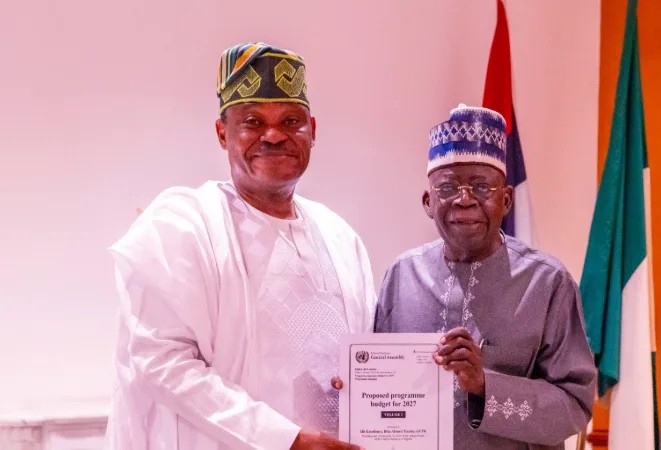
President Bola Ahmed Tinubu has been presented with copies of the proposed 2027 United Nations budget, marking what Nigeria’s Permanent Representative to the UN, Ambassador Jimoh Ibrahim, described as a historic milestone in the country’s engagement with the international organisation.
The presentation took place at the State House in Abuja, where Ibrahim, who chairs the United Nations General Assembly’s Fifth Committee responsible for administrative and budgetary matters, formally delivered the seven-volume budget document to the Nigerian President.
The development is significant because, according to Ibrahim, it represents the first time in 66 years that a Nigerian president has received the proposed UN budget through the process, underscoring Nigeria’s participation in the organisation’s budgetary affairs and its role in international diplomacy.
Speaking to journalists after the presentation, Ibrahim explained that the document originated from the UN Secretary-General and was transmitted through the General Assembly’s Fifth Committee, where member states examine the organisation’s financial requirements and administrative priorities.
He said, “This is the presentation of the United Nations proposed budget for 2027 that was presented to me by the General Assembly, by the Secretary-General of the United Nations to the Fifth Committee, and that budget has seven volumes.
“So it has to be presented to my country because my country is a member of the United Nations. I share the budget at the committee, so the appropriate thing to do is to bring the budget home and deliver it to the President.
“This is the first time in 66 years that Nigeria will share budget in the committee. The first time. So I don’t know when we’re going to do that again in history.”
The Nigerian envoy further described the presentation as an important moment for the Tinubu administration, noting that the opportunity to receive the comprehensive budget document reflected Nigeria’s place in the multilateral process through which the United Nations determines its financial commitments and operational priorities.
Ibrahim added, “President Bola Tinubu is making history to have been able to receive that budget, being the first President in 66 years that will receive such budget from the United Nations, and it’s not a small issue for a country to receive the whole UN budget.”
According to Ibrahim, the proposed 2027 budget covers the United Nations’ regular operations and its peacekeeping activities across different parts of the world. He cited approximately $3.4 billion for the organisation’s regular budget and $8.5 billion for peacekeeping operations, which support the UN’s administrative responsibilities and international peace and security missions.
Ibrahim put the overall proposed budget at approximately $14 billion, although the two component figures he cited amount to $11.9 billion, leaving a difference of about $2.1 billion that was not accounted for in his explanation.
He also clarified that the document remains at the proposal stage and should not be interpreted as an approved financial framework. The figures will be examined by UN member states, with possible adjustments before the final budget is adopted and expenditure begins.
“The budget still has to be approved. This is a proposed budget. It’s at the proposed stage. You submit it to your country, and thereafter the budget is finally discussed. Figures are adjusted, and then finally the final budget is approved and spending commences,” he said.
The budget approval process is a critical component of the United Nations’ financial administration, as member states review proposed expenditures, assess operational priorities and deliberate on the resources required to sustain the organisation’s programmes and peacekeeping responsibilities.
Beyond the presentation, Ibrahim was also asked about the potential benefits Nigeria could derive from the United Nations and the extent to which the proposed budget might translate into specific opportunities for the country.
He explained that discussions surrounding the budget were still ongoing and declined to identify particular benefits Nigeria might receive, indicating that the process had not reached the stage where such outcomes could be specified.
However, he pointed to the construction of a $267 million United Nations conference centre in Kenya as an example of the organisation’s investment in facilities within member states, highlighting how UN-related projects can contribute to infrastructure development and international engagement in host countries.
The reference to the Kenyan facility offered an illustration of the scale of investment associated with the organisation’s operations, although Ibrahim did not announce any comparable project or financial commitment for Nigeria.
Nigeria remains an active member of the United Nations, participating in diplomatic engagements and multilateral discussions on international security, development, administration and global cooperation. The presentation of the proposed budget to Tinubu brings the country’s involvement in the organisation’s budgetary process into focus at a time when the financial requirements of international institutions continue to attract attention.
The seven-volume document will now proceed through further scrutiny and deliberations within the United Nations system before member states approve the final figures. Until that process is concluded, the proposed allocations remain subject to review, adjustment and formal approval.
While the presentation has been described by Ibrahim as a historic event for Nigeria, the ultimate financial implications of the proposed 2027 budget, including any specific benefits for the country, will depend on the outcome of the UN’s budget approval process and any subsequent decisions concerning its operations and investments.