NEWS
President Tinubu Won’t Face Arrest, Movement Restrictions in US During UNGA, Envoy Says

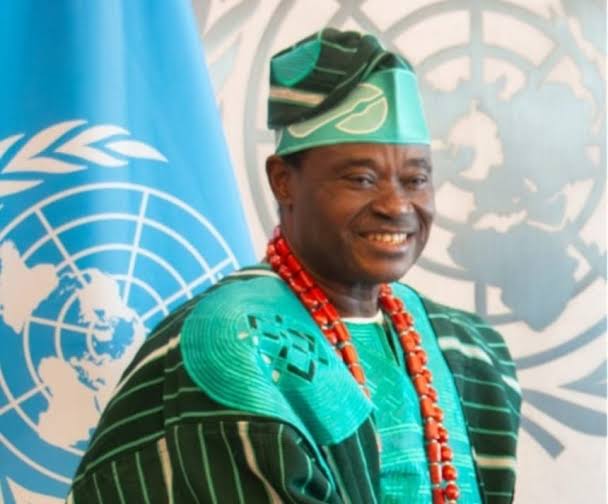
Nigeria’s Permanent Representative to the United Nations, Ambassador Jimoh Ibrahim, has dismissed concerns that President Bola Tinubu could be arrested or have his movement restricted in the United States if he attends the 81st session of the United Nations General Assembly in New York.
Ibrahim said there was currently no communication from the United States government to the Nigerian Mission to the UN suggesting that Tinubu would face any such restrictions during the high-level gathering.
The clarification comes amid renewed controversy over allegations concerning Tinubu’s past in the United States and ongoing efforts by a US-based political advisory and lobbying firm, Von Batten-Montague-York, to obtain historical records from American law-enforcement agencies.
The debate has intensified ahead of the UN General Assembly, where world leaders and senior government officials are expected to converge on New York to discuss major global issues.
Ibrahim, who also chairs the United Nations Committee on Budget and Administration, said representatives of UN member states enjoy protections under Section 11 of the 1947 UN-U.S. Agreement.
According to him, the agreement provides protection for representatives of member states and their families against impediments while travelling to and from the UN headquarters district.
He explained that the protection extends to UN officials, officials of specialised agencies and individuals invited to the UN headquarters district for official business.
On that basis, Ibrahim said there was no indication that Tinubu would be prevented from travelling freely within the scope of the protections applicable to participants in the General Assembly.
The ambassador also emphasised the difference between an allegation and a criminal offence established through the courts.
He argued that an accusation alone does not automatically make an individual a criminal, insisting that allegations must be subjected to due process and tested against the required legal standard.
Ibrahim maintained that anyone making a criminal allegation should be ready to establish the claim beyond reasonable doubt.
He added that “where a conviction cannot be secured in a sensitive criminal matter, the consequences could include substantial compensation.”
The envoy also dismissed suggestions that sustained social media campaigns could translate into a legal basis for arresting the Nigerian president.
According to him, “social media cannot criminalise or arrest President Bola Tinubu, no matter how much the opposition invested in it, those efforts will only end as an exercise in futility.”
The controversy surrounding Tinubu’s proposed attendance at the UNGA is linked to a long-running dispute over historical records associated with a US narcotics investigation involving individuals connected to him.
US authorities had previously pursued a civil forfeiture case involving approximately $460,000 connected to Tinubu. However, the case did not result in a criminal conviction against the Nigerian president.
The issue has resurfaced following attempts by Von Batten-Montague-York to secure records from US agencies, including the Federal Bureau of Investigation and the Drug Enforcement Administration.
The organisation has made allegations linking Tinubu to heroin trafficking during the 1980s and 1990s. Those allegations, however, have not resulted in a criminal conviction against the Nigerian president.
In a statement posted on its verified X account, the organisation said there was “no plan to arrest Nigerian President Bola Tinubu over his alleged involvement in heroin smuggling if he attends the United Nations General Assembly this month.”
While ruling out an arrest plan, the organisation claimed Tinubu could face a publicity campaign and possible embarrassment during his presence in New York.
It further stated, “We will continue to ensure that the White House and Congress fully understand that Nigerian President Tinubu is an alleged heroin trafficker and a liability to President Trump and the United States.”
The firm has also opposed any potential private meeting between Tinubu and US President Donald Trump during the UNGA, arguing that members of the Trump administration are aware of the allegations surrounding the Nigerian leader.
The Nigerian government, however, has rejected attempts to portray the dispute over access to historical US government records as evidence that Tinubu is currently facing a criminal prosecution in America.
The Presidency has maintained that the legal battle centres on efforts to obtain government records and does not establish that Tinubu has been charged with heroin trafficking in the United States.
Despite the government’s position, the issue has generated renewed political debate in Nigeria and the United States, particularly with Tinubu’s possible trip to New York placing the controversy under renewed international attention.
Ibrahim also explained that participation in the UN General Assembly is not dependent on personal invitations issued individually to presidents.
Rather, he said, member states are invited to participate in the high-level session, giving countries the discretion to determine who will represent them.
He noted that more than 60 per cent of the current speaking list consists of vice presidents and foreign ministers representing their respective countries.
This, he explained, means a president does not necessarily have to attend personally and can delegate representation to another senior official depending on the circumstances and priorities of the country.
The Nigerian envoy also recalled a previous instance involving a former Nigerian president, stressing that the individual was not Tinubu, who was reportedly restricted to a 10-kilometre radius from the UN headquarters while attending the General Assembly over a drug-related allegation.
Ibrahim said the allegation in that case was never established, using the episode to underline the importance of evidence and due process before an individual can be treated as having committed a criminal offence.
He further explained that US law-enforcement agencies have the authority to invite individuals to provide information or make statements as part of investigations.
Such investigations, he said, can involve the collection of extensive personal information, including family background, personal history, parental records, information concerning children, educational history and fingerprints.
According to him, investigators may use such information to establish relationships between individuals, organisations, groups and broader networks during an investigation.
However, Ibrahim stressed that information collected by law-enforcement agencies during investigations is subject to protections and should not automatically be assumed to be material that must be released publicly.
He particularly noted that sensitive information connected to financial investigations and other criminal allegations may remain protected, reinforcing the distinction between investigative records and evidence of a criminal conviction.
With the UN General Assembly approaching, the debate over Tinubu’s possible attendance is therefore expected to remain a subject of considerable political interest, even as Nigeria’s UN envoy insists that there is currently no indication that the Nigerian president will face arrest or movement restrictions in New York.